 |
and More Shop Tips
|
|||||||||
 |
||||||||||
|
|
||||||||||
|
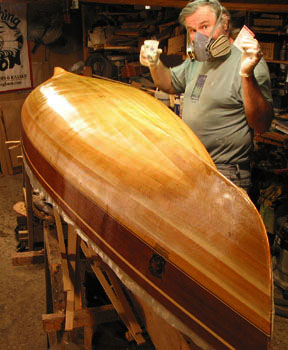
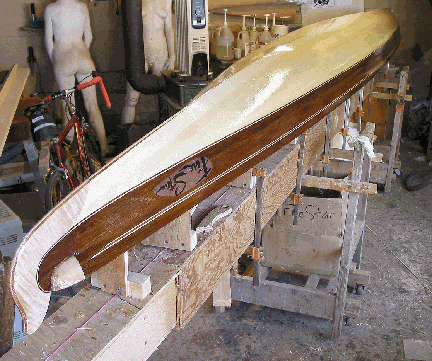
How-to Make a Transparent Glass Lay-up The Task The results of each technique can vary greatly depending on the skill, patience, powers of observation, ability to visualize, experience, and dumb luck of the person applying that technique. These are a lot of variables beyond the control of most novices. However, there are a lot of variables that can be controlled. This is my experience with fiberglass and epoxy lay-ups. What works well and not-so-well. “Good judgement is the result of experience and experience the result of bad judgement.” - Mark Twain The Problem Epoxy Epoxy is similar in viscosity to pancake syrup. At 70˚ F. it is fairly thick. In colder temperatures it will become thicker and in warmer temperatures it will be thinner. So external/shop temperature is an important variable in changing the viscosity when handling epoxy. To change the epoxy into a solid, a hardener is added to create a chemical reaction and this chemical reaction produces heat. This internal heat generated by the epoxy mixture is greater when the epoxy is in a mass like a mixing cup, or it can be slowed by spreading it thinly in a flat tray (like a roller tray) or spread in a thin coating. So warmer epoxy cures faster, cooler epoxy cures slower. The wild card is the hardener. So to work with epoxy you must think about the external heat, room temperature, and how the hardener creating internal epoxy heat will work with or against the external temperatures. Typically, if you have colder temperatures you would want to use a faster hardener to counter the exterior cold with interior epoxy heat. BUT, since the cold external temperature will make the epoxy thick and the fast hardener will cure quickly this scenario is a poor one for wetting out fiberglass cloth as the thick resin will cure before the glass can be saturated. If you are working in higher room temperatures you would add a slower hardener to counter the room temperature influence to make the epoxy cure too fast. AND warm room temperatures will make the epoxy thin and slow hardeners will give the epoxy a long cure time, both of which are ideal for wetting out the fine twisted fibers of glass in fiberglass cloth to a transparent condition. REAL pancake syrup, poured on a surface, will self level over time since the viscosity does not change. The moment you mix hardener with epoxy resin the epoxy mix is getting thicker, reducing it's leveling capacity. Since epoxy resin / hardener mix is changing the viscosity immediately, the epoxy mix may or may not have enough time to level as it cures. Most often the epoxy does not have enough time to level, so it reflects the rough texture of the fiberglass cloth. Faster hardeners and warmer temperatures also make the epoxy molecules dance faster so they will cure (freeze) in a rougher surface. Each epoxy manufacturer has different ideas of what an epoxy should do, so they mix different additives giving each epoxy different characteristics. I have worked with West System epoxies, MAS and System Three epoxies. Each is different and the hardener combinations of each epoxy add more variables. If epoxy is applied to a smooth surface it can create a smooth surface when cured. Epoxy is thick at room temperature. Mix it up and pour it on a flat surface and unless the surface is PERFECTLY flat, epoxy will run right off an edge. Slowly, but surely! This gets a lot of people in trouble because they want to have a thick coat of epoxy. The novice tendency is to apply a thick coat and find out later, how epoxy drips and runs and flows onto the floor, even though it looked nice and smooth ten minutes ago. The best controllable method of building up a greater thickness is with a number of thin even coats of epoxy. Laminating with Epoxy Epoxy is a syrup consistency. Lay-up transparency with fiberglass cloth can only be achieved if you can make the epoxy thin enough to totally wet-out the cloth, so all the air is displaced and every fiber is wet. If your epoxy resin is not nearly as thin as water it will not totally wet-out your fiberglass cloth. If the glass has a silvery look to it from certain angles, it has not been totally wet-out. Some epoxy manufacturers advertise epoxy that will cure at low temperatures. None of these are intended for totally transparent fiberglass wet-out! If you can only raise room temperatures to 70 degrees you may be able to get a decent transparent wet-out of fiberglass cloth with one of the special very thin wet-out epoxies, but you will pay extra for these resins and they are not for weave filling or gluing purposes. Understanding how to make epoxy thin enough, for a long enough time, is critical to solving the glass transparency problem. EVERY epoxy is different! Every epoxy manufacturer has a different formula that has qualities that can be an advantage or a disadvantage. For instance, the System Three General Purpose resin I use, with slow hardener at 85˚ is great for glass wet-out. It allows all bubbles to dissipate and results in a transparent lay-up. System Three says I can re-coat up to 72 hours without sanding. MAS epoxy works well at 80˚ and sets-up in half the time. MAS says I must sand after it is tack free. I've had a lot of problems with bubbles in the fill coats using MAS, even with tipping off or hitting bubbles with a heat gun. System Three goes on smooth and bubbles are easily removed by tipping off with a foam brush to produce a surface as smooth as varnish. I'm currently wetting -out my exterior glass and fill coating with System Three General Purpose resin. I use MAS for interior glassing and gluing parts due to its faster set-up. System Three resins provide a huge advantage for the home builder, over other resins. System Threes resins provide a chemical bond for up to 72 hours before sanding between coats is necessary! All System Three hardeners have a longer cure time than other resin systems. Longer cure time means, more time for bubbles to dissipate, more time to allow the resin to totally wet-out cloth and wood, and this allows the resin to trap less bubbles to begin with curing to a smoother, bubble free surface, requiring less sanding than other resins. These features make it the best for home builders because, the home builder does not need to rush, or worry about the resin setting-up before they finish application. And the long chemical bonding window means you can do a seal coat one night, a glass wet-out the next night, a fill coat the next night and so on. This breaks the tasks into smaller, less rushed, easier steps, and reduces variables. System Three epoxy cures to a smooth surface requiring less sanding. System Three is not paying me for this endorsement. I think this is significant information to make strip building easier for the novice. Fiberglass Usually, a more open weave glass will wet-out better and produce a more transparent lay-up than tight weave fiberglass cloth. I've used some tight weave 4 oz. glass that would not wet-out to a transparent level and remained looking slightly white. I use open weave 6 oz. e-glass and 4 oz. s-glass for my strippers. Fiberglass cloth absorbs epoxy resin slowly, so give it time to absorb. The epoxy must displace all the air surrounding each fiber in each strand in the cloth to become transparent. It's best not to over work resin into a small area until the glass is totally wet-out because this can introduces bubbles. Apply resin to the cloth and move on, to coat the next area, giving the resin a little time to soak in. Fiberglass cloth is coated with a special sizing to make it compatible with epoxy resin. This sizing is sensitive to water and can be damaged or removed if water comes in contact with it. The result will be a glass weave that looks white. Be careful not to have water on a surface or on your hands, that could come in contact with fiberglass cloth. Be wary of a "sale" on cloth that might be water damaged. |
||||||||||
 |
||||||||||
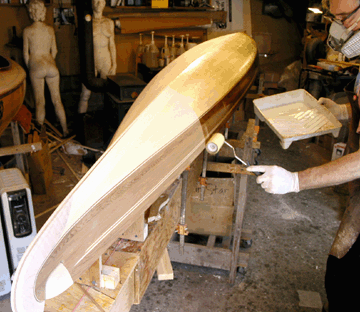
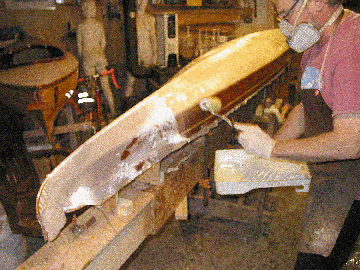
Strategies to Make and Keep Epoxy Thin for a Transparent Lay-up Heat Recently, West Systems published a chart, showing when their epoxy was at 70˚, it became twice as thin and more, when heated to between 75˚ and 85˚. I suspect other resins will do the same, so heat is a critical factor in achieving a transparent lay-up. BUT heating the resin alone is useless if it is applied to cold materials. Slow Hardener -To counter the quick set-up nature of epoxy when exposed to heat you must use a slow hardener which is designed to slow the epoxy set-up in higher temperatures. Small Batches - Epoxy will also set-up more quickly in larger batches, because the mass of resin will generate it's own heat, speeding set-up. Smaller batches (I never mix more than 6 oz. at a time) keep the resin from generating heat and keep the resin thin. Furthermore, epoxy in any size batch will start to thicken the moment hardener is mixed in, so using multiple small batches will keep the resin thinner over application work time. Flat Tray - After the resin is mixed it should be immediately poured into a flat tray. Spreading the resin out into a thin layer will retard the set-up process, keeping the resin as thin in consistency as possible. Roller - The flat tray and roller work together to keep resin thin and spread a thin even coating of resin on the wood or fiberglass for the best penetration and wet-out. Thin Resin - The bottom line is that if your resin is not as thin as possible, you will not wet-out the fiberglass to a transparent level. Manufacturers will tell you, you can work down to X degrees but that doesn't mean you'll have a transparent lay-up. They're in the business of selling resin, so they are going to tell you what you want to hear. I've learned epoxy loves heat. Give it a nice very warm place and it will wet-out glass, dissipate bubbles and saturate wood very nicely. Methods of resin application: The rough surface of the weave of fiberglass cloth naturally creates bubbles and foam with all application methods. Squeegee - Spreading a pool of resin is quick on a flat surface. This is great for small surfaces like bulkhead panels. On curved surfaces you must chase runs or let them fall. This makes controlling the resin application dependent on slope and gravity. On vertical surfaces application of resin is very difficult at best. Gravity is in control, not you. A cup full of resin and the means to spread it around, makes it irresistible to pour a lot on the fiberglass and smear it about. A large batch of resin in a cup will set-up fast. Resin poured on fiberglass will make the fiberglass float on top of resin and wet wood unevenly and can leave a blotchy appearance. The pool of resin, whether above or below the glass, will be forced through the glass weave by the squeegee. As the squeegee presses down on the glass, especially when the glass is floating on resin, a wave of glass precedes the squeegee edge, forcing resin through the weave, creating a micro foam that will give the glass a milky appearance. This micro foam is very hard to remove or dissipate. Wood/glass can be starved for resin if the squeegee and pool of resin passes over the cloth too quickly. All these issues are a big negative to me for wetting-out large areas of glass. Would you paint your walls using a squeegee? The mess involved in doing so is obvious. Just because a lot of the surfaces on your boat are not vertical doesn't mean you won't end up with a terribly uneven blotchy application. Spreading resin on the interior of a hull seems like a natural right? Big bowl shaped surface, the resin can't run off of. This is one of the biggest mistakes you can make. Again, pouring a pool of resin on glass will soak through and float the glass on the excess resin. When the resin thickens (as it does from the second you add hardener) you will have a lot of excess resin trapped under the glass adding unnecessary weight to your boat. The only positive for the use of a squeegee for resin application is that it's CHEAP. If you really get off on being cheap you'll love the squeegee because you can use it over and over and not pay for roller covers or disposable brushes. I only use the squeegee for removing excess resin from the glass wet-out (See photo below / right) or for small flat panels, like bulkheads, where they will not be seen. Brush - I just don't like the brush method. The amount of resin a brush will hold is small. Application is slow. The coating is irregular which means more sanding to level. More sanding of an irregular surface makes a fair surface harder to achieve. Little foam is generated, which is the only appeal of the brush method for me. However the need to brush over and over to spread out the resin in a uniform coating introduces more opportunities for bubble generation. Both the squeegee and brush methods will work more naturally, directly out of the epoxy mixing cup. This will cause your resin to set-up more quickly, wet-out fiberglass poorly and add weight to your boat. Roller - I like the roller method best. The roller can apply a thin even coat of resin quickly. If you have drips or runs you're applying too much. The roller allows great control of how the resin is applied. This is very important because this allows you to roll on resin on the cloth bias (diagonal strokes to the cloth weave) which will smooth out any wrinkles in the cloth during application. The one thing most people don't like about foam rollers is that they CAN generate foam in the resin. If you roll back and forth vigorously you will generate foam, so don't do this! 95% of foam can be eliminated by allowing the foam roller cover to absorb resin BEFORE you try to apply resin to the boat. If you follow my suggestions below for thinning your resin, any foam will dissipate during the glass wet-out. Foam generated during fill coats can simply be removed by "tipping off" (dragging the tip of the foam brush) over the resin surface with a dry 4" foam brush. I find this tipping off a real advantage because it also allows me to smooth any out drips/runs I didn't see and results in a smooth surface requiring less sanding. I've found MAS epoxy especially prone to holding bubbles and requires going over the surface with a heat gun to pop them, along with the rest of the technique above. If you find you have problems with drips and runs you are applying too much resin! This is easy to do with Squeegee and Brush and the will to fill that weave. Three thin coats with a roller (you can put on too much with a roller also) will save time over sanding and scraping drips and runs. |
||||||||||